1. Overview of Competitor Research
Competitor research is an essential part of business strategy development. By analyzing external factors and current competitors, companies can determine their position in the market. This research not only helps capture competitor movements but also helps businesses build appropriate strategies to enhance competitive advantage.
2. What is SWOT Analysis and its Role in Competitor Research
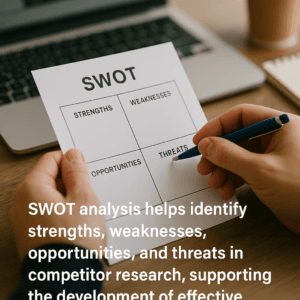
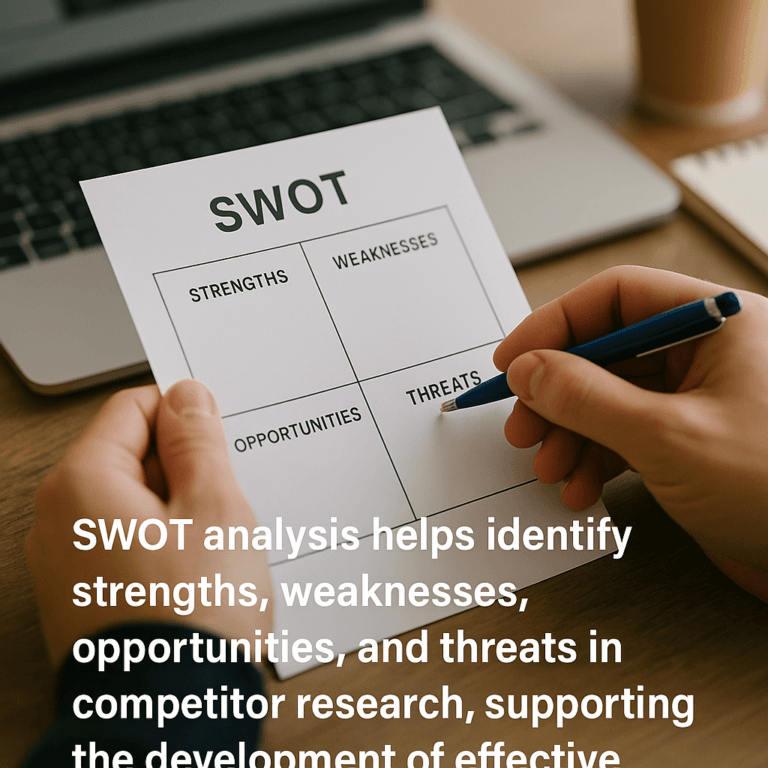
SWOT analysis is a strategic analysis tool that helps identify:
- Strengths: Internal factors of the business that create an advantage.
- Weaknesses: Limitations or deficiencies that the business needs to address.
- Opportunities: External factors that can be leveraged for growth.
- Threats: Adverse conditions that may affect development.
Conducting SWOT analysis in competitor research not only helps businesses identify their position but also gathers information about competitors, enabling the development of effective competitive strategies.
Factors in SWOT Analysis
An effective SWOT analysis needs to cover all relevant factors. Therefore, collecting accurate and comprehensive data is crucial. Businesses can conduct surveys, interviews, or analyze reports to gather necessary information.
3. TOWS Matrix and Its Application in Competitive Strategy
TOWS Matrix is a tool extending from SWOT analysis, helping businesses determine strategies based on the relationships between the factors in SWOT. The TOWS matrix allows businesses to:
- Develop strategies to leverage strengths to exploit opportunities.
- Address weaknesses in dealing with threats.
- Create relevant strategies by combining the factors in SWOT.
What Factors Does TOWS Matrix Analyze?
The TOWS matrix analyzes four main factors as follows:
- SO (Strengths-Opportunities): Strategies focused on using strengths to exploit opportunities.
- WO (Weaknesses-Opportunities): Strategies that help overcome weaknesses to seize opportunities.
- ST (Strengths-Threats): Strategies using strengths to mitigate the impact of threats.
- WT (Weaknesses-Threats): Strategies to minimize weaknesses and cope with threats.
4. Comparison and Relation Between SWOT and TOWS Analysis
Although SWOT and TOWS analysis both help businesses analyze and strategize, they have different approaches. SWOT focuses on identifying internal and external factors, while TOWS focuses on developing strategies based on those factors. Therefore, using both tools simultaneously helps businesses gain a more comprehensive view of the market and competitors.
5. Practical Applications of SWOT & TOWS in Competitor Analysis
Applying SWOT analysis and TOWS in practice helps businesses quickly recognize the strengths and weaknesses of competitors. From there, businesses can establish competitive strategies aligned with their development goals.
Competitive Advantage from SWOT Analysis
Conducting SWOT analysis helps businesses better understand their strengths and how they can be leveraged to create market advantages.
Identifying Risks and Opportunities Through TOWS
From the TOWS matrix, businesses can plan details to deal with risks and seize new opportunities.
6. Specific Examples of SWOT & TOWS Analysis for a Competitor
SWOT Analysis for Company A
Company A has a strong brand in the production and distribution of products but struggles to access new distribution channels. Below is the SWOT analysis:
- Strengths: Reputable brand, extensive distribution network.
- Weaknesses: Lack of technological innovation in production.
- Opportunities: Market demand for new eco-friendly products.
- Threats: Intense competition from foreign brands.
Applying the TOWS Matrix to Develop Strategies for Company A
Based on the SWOT analysis, Company A can use the TOWS matrix to develop the following strategies:
- SO: Focus on developing eco-friendly products and utilizing the strong brand for promotion.
- WO: Invest in new technology and partner with strategic collaborators.
- ST: Enhance advertising and promotions to maintain market share.
- WT: Strengthen internal processes to improve production efficiency to reduce costs.
7. Tools Supporting Effective SWOT and TOWS Analysis
To carry out effective SWOT and TOWS analysis, businesses can utilize several tools such as:
- Market Surveys: Help collect customer and competitor information.
- Competitive Analysis Reports: Provide information about competitors in the industry.
- Online SWOT Analysis Tools: Assist in planning and analyzing.
8. Conclusion: The Importance of SWOT & TOWS in Competitor Research
SWOT and TOWS analysis are not only useful tools for competitor research but also provide a foundation for businesses to build effective business strategies. Maximizing the elements of SWOT and TOWS will help businesses not only seize opportunities but also overcome challenges in an increasingly competitive market.
Contact us today for tailored consultation!
Intage Vietnam: Your trusted partner for comprehensive and effective market research solutions.
📞 (+8428) 3820 5558
🌐 https://intage.com.vn/
🏢 1st floor, Citilight Tower, 45 Vo Thi Sau St., Tan Dinh Ward, HCMC