

Research insights
E-Commerce Competitor Analysis: Evidence Before SWOT
E-commerce competitor analysis compares how alternative sellers or platforms meet a defined customer need. A strength or weakness is meaningful only relative to that need and the evidence available. A broad label such as fast delivery or poor service can conceal major differences between products, locations and occasions.

On this page
Begin with a decision: improve a product offer, choose a channel or resolve a customer-experience gap. That determines which competitors and criteria belong in the analysis. A list of famous platforms is not automatically the relevant competitive set.

Choose alternatives customers genuinely consider
Identify direct sellers, marketplaces, specialist stores and other ways of completing the task where relevant. A marketplace and an individual merchant are different units. Avoid comparing the platform’s overall reputation with one seller’s product performance.
For a hypothetical small-appliance purchase, ask which options customers actually examined and why they rejected some. A local retailer with immediate stock may be an alternative to an online listing even if it does not resemble the largest marketplace business.
Compare the complete offer
Record the exact product, version, quantity, observed price, eligibility conditions, delivery location and time of observation. Include relevant fees and service terms. A promotional listing available only to selected members should not be treated as the ordinary price for everyone.
Repeat observations where the question concerns consistency. One available delivery date does not establish a permanent speed advantage. Distinguish a stated promise from an observed fulfilled outcome, and keep the source for each entry so another reviewer can understand the comparison.
Use customer feedback with its limitations
Reviews can reveal issues to investigate, but they are not a representative satisfaction survey. Check which item, seller and period a review concerns. A damaged parcel, misleading size description and slow response need different interpretations.
Look for recurring themes across relevant evidence rather than counting a few dramatic comments as proof. Include customer interviews or a suitable survey when the business needs to know how widespread an issue is. Report recruitment and question wording with the findings.
Agree who records observations and how ambiguous entries are reviewed. Consistent collection rules help distinguish a genuine change in the offer from a difference in how two reviewers interpreted it.
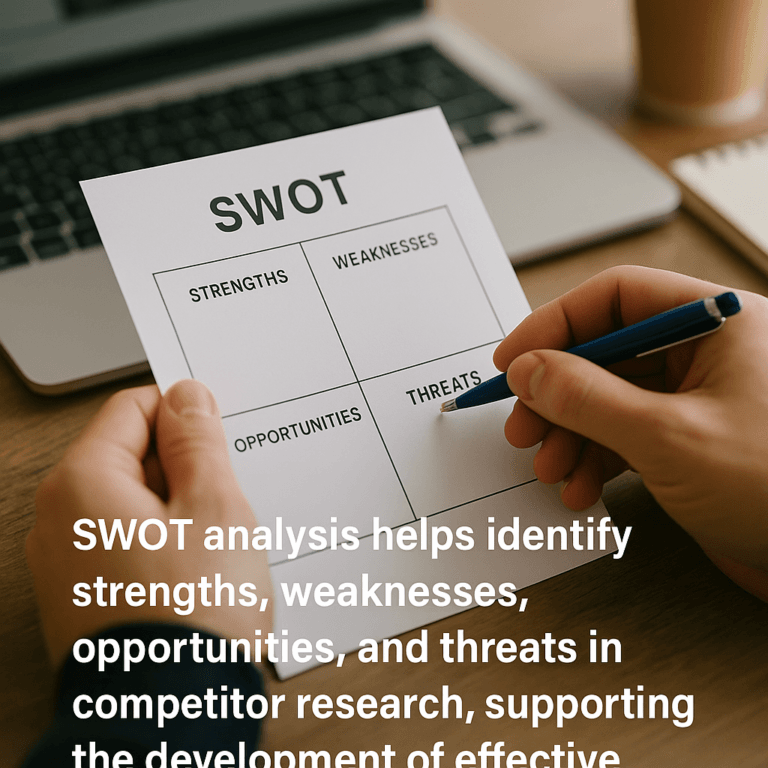
Build SWOT after the evidence table
Separate observed attributes, customer interpretations and analytical hypotheses. An offer that shows stock clearly is an observed feature; customers finding it reassuring is a research finding; expecting it to improve conversion is a hypothesis until tested.
Keep strengths and weaknesses within the defined comparison. Opportunities and threats concern the external context rather than a duplicate list of features. Unknown financial resources or management ability should remain unknown unless reliable public evidence supports an assessment.
Turn the finding into one actionable response
If customers cannot compare specifications, improve the relevant information. If a delivery promise is difficult to honour, address operations before increasing its prominence. Copying a competitor’s promotion may be less useful than solving a task they and the business both handle poorly.
For a Vietnam-focused review, state the geography, category and period. Do not generalise a result from one city or seller into a nationwide platform ranking. Revisit the comparison when a material change affects the decision rather than repeatedly collecting unrelated observations.
Explore market research services and contact INTAGE Vietnam with the competitive question and intended use. A useful analysis is traceable, comparable and specific enough to support a change the business can deliver.
Related reading

Latest posts
- Market Research: Building a Market Research Report for Investment Funds
 Survey Sample Size: How Many Respondents Are Enough?
 Survey Data Collection Methods in Vietnam: How to Choose
- Technology Adoption in Enterprises: How to Research Employee Behavior
 How to Write a Market Research Brief for an Accurate Quote

