

Research insights
Household Health Care Products: How to Research Consumer Needs and Buying Behaviour

On this page

Household health care products are the items families keep at home to look after everyday health and hygiene, such as thermometers, blood pressure monitors, first-aid supplies, masks, hand sanitisers, air purifiers and personal care devices. For a business, the useful questions are who buys each product, for which family member, through which channel, and what makes them trust one brand over another. Consumer research answers these questions with surveys, qualitative research and purchase data.
This article is about market and consumer research. It does not give medical advice, and claims about health effects must follow the applicable regulations.
What counts as a household health care product?
The category is broad, which is why research should start by defining it clearly:
- Measuring devices: thermometers, blood pressure monitors, scales and other home devices, some of them connected to apps.
- First aid and hygiene: bandages, antiseptics, masks, hand sanitisers and disinfectants.
- Home environment: air purifiers, humidifiers and water filters.
- Personal care devices: massage devices, electric toothbrushes and similar items.
- Supporting services: apps and remote consultation services that families use alongside products.
What drives household demand?
Several general factors shape demand: more attention to prevention and hygiene, ageing family members who need regular monitoring, young parents caring for children, and wider access to products through pharmacies, supermarkets and e-commerce. Their weight differs between households, so a business should measure them for its own target group rather than rely on general trend statements.
Purchase is often a family decision. The person who buys may not be the person who uses the product, and advice from pharmacists, doctors, relatives and online reviews can matter as much as advertising.
What should you measure?
| Business question | What to measure | Method |
|---|---|---|
| Who buys and for whom? | Buyer, user, household profile, life stage | Survey, U&A study |
| Why do they buy? | Purchase triggers, needs, occasions | In-depth interviews, in-home visits |
| Where do they buy? | Channel use: pharmacy, supermarket, e-commerce, convenience store | Survey, shopper panel |
| How do they choose a brand? | Trust factors, role of pharmacist advice and reviews, price sensitivity | Survey, focus groups |
| Is the product easy to use? | Ease of use, satisfaction, problems in daily use | Home use test (HUT) |
| Do they buy again? | Repeat purchase, switching between brands | Shopper panel |
How do you research household health care consumers in Vietnam?
- Observe use at home. In-home visits and in-depth interviews show where products are kept, who uses them and which tasks are difficult, for example an older parent reading a monitor.
- Measure the category with a survey. A usage and attitude survey sizes ownership, usage frequency, channels and brand choice by household type. A bias-free questionnaire is important because health topics invite socially desirable answers.
- Test products and packaging. A CLT or HUT checks whether instructions, displays and packaging are clear for the real users.
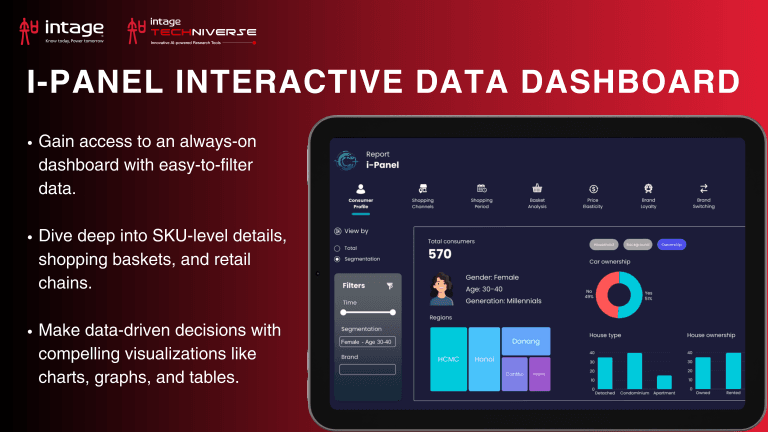
- Track purchases. For products sold through retail, purchase data such as i-Panel, INTAGE Vietnam’s shopper panel based on receipts and barcode scans, shows which shoppers buy, where, and whether they come back.
What are common mistakes?
- Relying on vague market forecasts. Statements that a market will grow do not show whether your product fits a specific household need.
- Interviewing only the buyer. Include the users, such as older relatives, and the advisers, such as pharmacy staff.
- Ignoring channel differences. Shoppers may research online but buy at a pharmacy, or the other way round.
- Making health claims in research materials. Concepts should describe the product accurately and avoid claims that cannot be supported.
How do you act on the findings?
Use the results to focus on the household segments with the clearest need, choose channels that match where they buy and seek advice, simplify product design and instructions for real users, and give pharmacy staff and retail partners the information customers ask for. Track repeat purchase after launch to see whether the product earns a lasting place in the home.
FAQ
What are household health care products?
They are items families keep at home for everyday health and hygiene, such as thermometers, blood pressure monitors, first-aid supplies, masks, sanitisers, air purifiers and personal care devices.
How do you research demand for home health products?
Combine in-home qualitative research on real use, a usage and attitude survey, product tests with real users, and purchase data to track buying and repeat purchase.
Who should be included in the research?
The buyer, the actual users in the household, and, where relevant, the people who advise them, such as pharmacy staff.
Research household health care shoppers
INTAGE Vietnam is a market research company in Vietnam and part of the INTAGE Group, Japan. We help brands understand household needs and buying behaviour with qualitative research, surveys, product tests and shopper panel data. See our market research services or contact us.
Related reading
Latest posts
- Market Research: Building a Market Research Report for Investment Funds
 Survey Sample Size: How Many Respondents Are Enough?
 Survey Data Collection Methods in Vietnam: How to Choose
- Technology Adoption in Enterprises: How to Research Employee Behavior
 How to Write a Market Research Brief for an Accurate Quote

